Laurance O'Tool
Tell me about yourself. What initially inspired you to pick up a paintbrush? What are the perks of being a self-taught artist?
My name is Laurence O’Toole and I am a realist painter from the Island of Ireland. I had always drawn as a child, it always held more sway over me than sports or other outdoor activities, so most of my time was spent finding paper or cardboard boxes, saving pocket money to buy coloured pencils, and then, drawing. I can’t say that I ever thought that I wanted to become an artist, as I never understood what that life might be. We were a working class family growing up in Ireland’s recession of the 1980s, but that meant nothing to me either, not when I was discovering dark shading and white pencil highlights, on yellow corn flakes boxes turned inside out.
I left school early, as I had been making a living at a young age, painting murals, shop front signs, portraits and landscapes for local exhibitions. I had that thirst for life and college was not an option, so at eighteen I decided I needed to see the world, rolled up my brushes and off I went - in a great big cloud of belief and naivety.I was away for ten years and although some were rough, unwelcome and arduous, they helped shape my thinking, sharpen my gaze, at life, at this world. And so now, I paint in narratives, I paint life’s narratives, as I see them, as I experience them, with honesty, my honesty. As a self taught artist, I mostly view my practice as being slightly out of step with academically trained painters, this is neither a bonus nor a loss, but a different approach, we did not learn what they were collectively taught, so we tend to arrive at what we are looking for from many different paths.
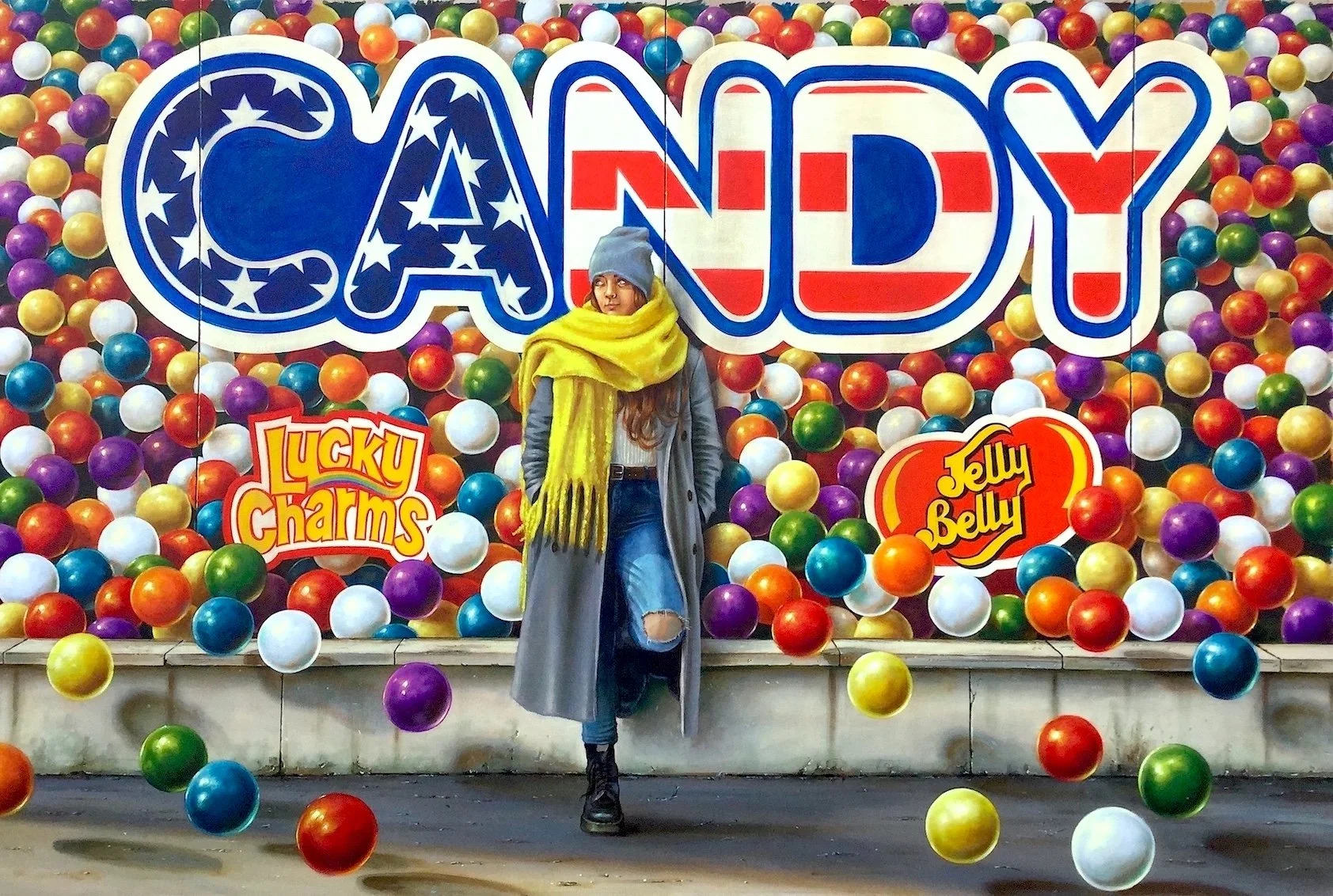
Candy - Acrylic on Linen 32”x 48” 2020
We were in Scotland and Jade had just bought herself a new scarf. It was cold but it was bright. We didn’t mind though, as we both loved Glasgow as a city break, it was raw and honest, kooky and fun, but man, it was damn cold. While wandering the streets I came across this old sweet shop, down on Argyle street and around the corner of it’s glass frontage, they were applying some new vinyl graphics. I stopped to watch them, not out of any interest in the application process of vinyl but because of the larger than life word of candy, complete with the stars and stripes and looking every bit as stunning as the promise of pleasure, it was making.
The idea that American culture is still making its mark on the world was interesting to me, how it is iconic, maybe always will be. It feels safe, reliable and very, very familiar.
I cajoled Jade to pose for me, on that busy street, in front of the new shopfront and in that short pose, I saw all the candy come to life and start spilling around her, I saw a fun, uncomplicated burst of life happening. I saw a chance to paint some goodness and I ran with it.
How have your surroundings influenced your artwork? Has travelling around the world inspired your practise?
I believe your surroundings will always influence your work, I can not be in one place and not have the colour, the light or the custom, seep into what I am doing. It is generally a subconscious happening, you are working on a piece and slowly it is carried by a current that is not part of your normal painting traits. I spend a lot of time in Spain and Portugal and they symmetry of the wonderful tile works that pepper their heritage is intriguing, all that colour, all that light, reflections and undulations. When in South America, that colour and the blazing sun, bleaching all that richness into submission, in Africa, the contrasts, the red oxides, the vastness, Australia, Canada, USA and now back to Ireland, where the light is very different to all these places. It can be very diffused, subtle, I find it allows me greater depth, sometimes.
Many of your figurative works are painted on a patterned background. Why is this?
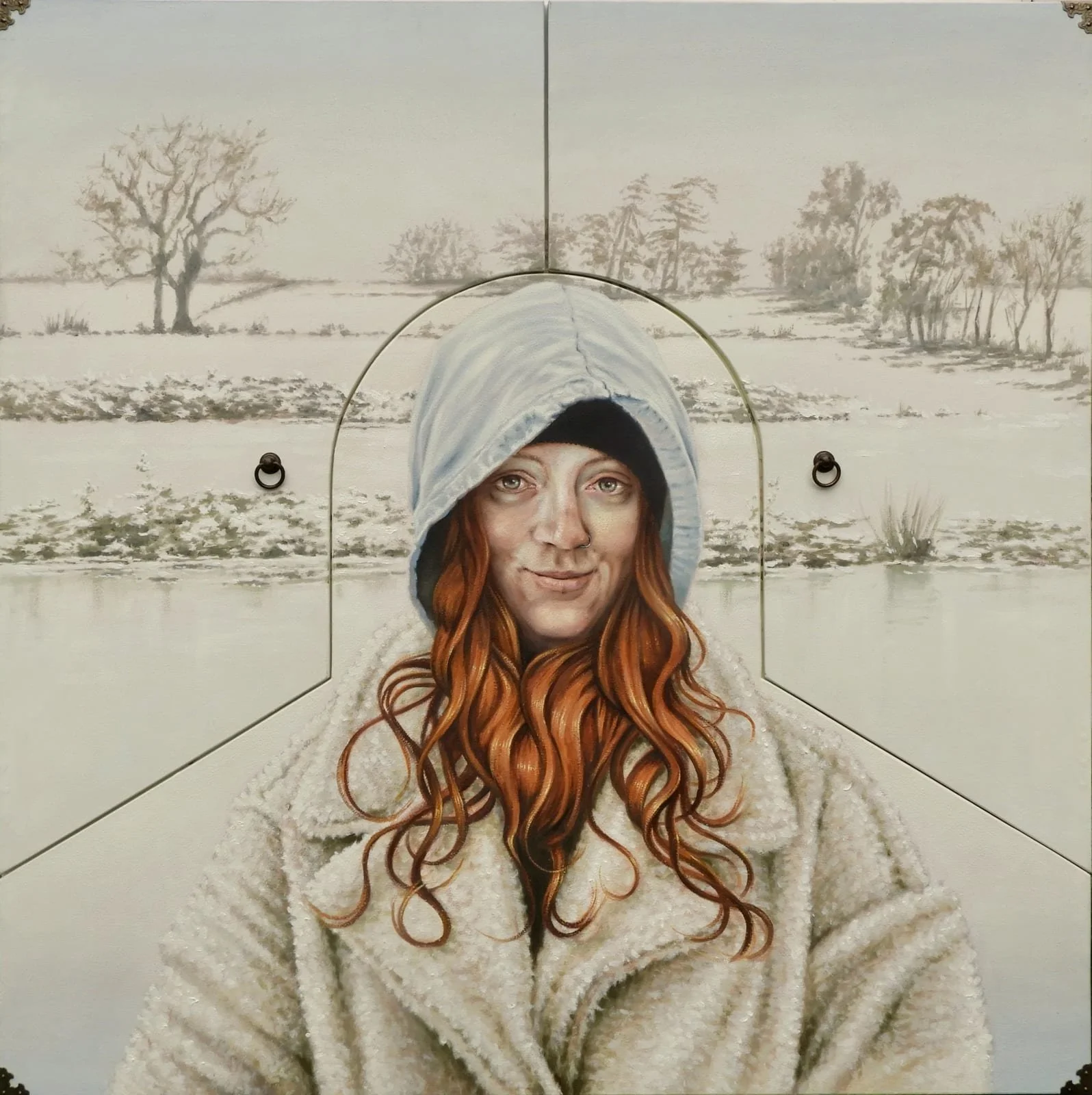
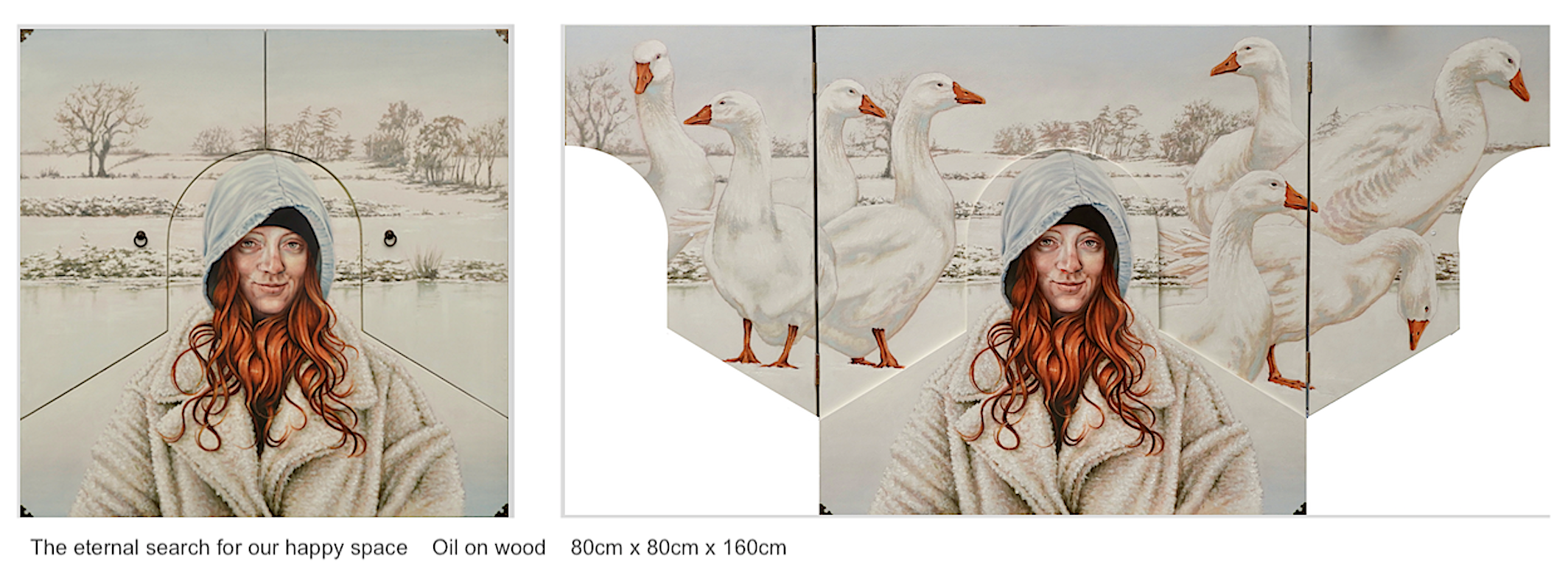
I am endlessly interested in pattern, that step and repeat, that symmetry and the need to be exact, for it does not work if it is not exact, patterns do not meet, when not exact. It’s a damned nightmare, that I enjoy very much. I also find that it allows the figure to live, when introduced to a chaos of organised tile, it can really help the viewer focus on the narrative I am building.

The Artist Amy Gibson - Oil on embroidered Silk 70cm x 50cm
I had wanted to do a portrait of my friend Amy Gibson, another Artist, I had been working in Spain at the time and noticing the elaborate traditional fabrics that were available there, I thought I could introduce them to my work. I had been thinking of moving away from the static sitters pose and trying to animate the work more, as I believe our gestures are very interesting, I wanted to to highlight them, and the reality is that none of this comes easy. In doing so I had Amy pose in a somewhat contrived manner, not to complicate it, but rather add some serious consideration. Then when I decided to approach her portrait on the embroidered silk, I knew the challenge matched the subject matter. It proved to be a difficult process but it also helped me to focus on what was important, and the patience paid off in the portraits focus and honesty. The truth in this making was keeping what was important in this portrait and removing everything that was simple distraction. The weave of the silk, the embroidered designs, running around and beneath the portrait, all add another layer to what I believe is a complicated, yet instinctive piece.
Thinking about your most recent painting, describe your creative process from start to finish. What is the narrative behind this piece?
My most recent work is ‘The Hereditary Beast Within’. It was a difficult piece as I had been working on a self portrait and I was having problems making the piece live up to the narrative. So, I abandoned it and started a new version of it. A double portrait that better explains the sense of change I was feeling, within. I had taken many selfies and had started to build up the composition, I draw in red pastel pencil always on a white canvas. The oil tends to absorb the chalk and leave very little trace of the construction behind. After one pass of oil, I have the canvas filled with tonal values, what I believe I am looking for. After this has dried, I will have to spend some days looking over it and now know what needs to change and this happens with the second pass, along with deepening of tones, the finding of light and the additions of any contrasts needed to bring it to life. It is when I can’t find any more changes that the piece is finished.
This is a piece I have thought long and hard about over the past year. It is a personal look at the self, how I see my practice, my ageing and my progress. Taken from a time last Summer, in a temporary studio I had on the top floor of an old mill in Thomastown, Kilkenny. It was hot and the windows were small but the skylights poured warm light into the vaulted, timbered room, full of giant wooden beams and old iron pulley wheels. There was an endless cooing of wood pigeons and shrieks of starling as they were nesting and building, bullying and fighting in the hidden spaces all around me. It was a good place to be, room to roam, room to work, time to think. And within that space I found myself thinking more about my past and all that is hereditary and base.
I have become more intolerant of what does not agree with me, of that, that does not fit, of a new world that I am growing out of and not into. I am of an age where this does not cause me concern, as my focus narrows more and more towards a final goal. I am in search of what is worthwhile in me, artwork that has worth, work that will not age but will have substance long after I am gone, and all the while I catch myself, raking my horns on rough rock and hard bark of trees, bellowing unnecessarily at some slight that I perceive as wrong.
And all the while, I am trying harder to contain the hereditary beast within.
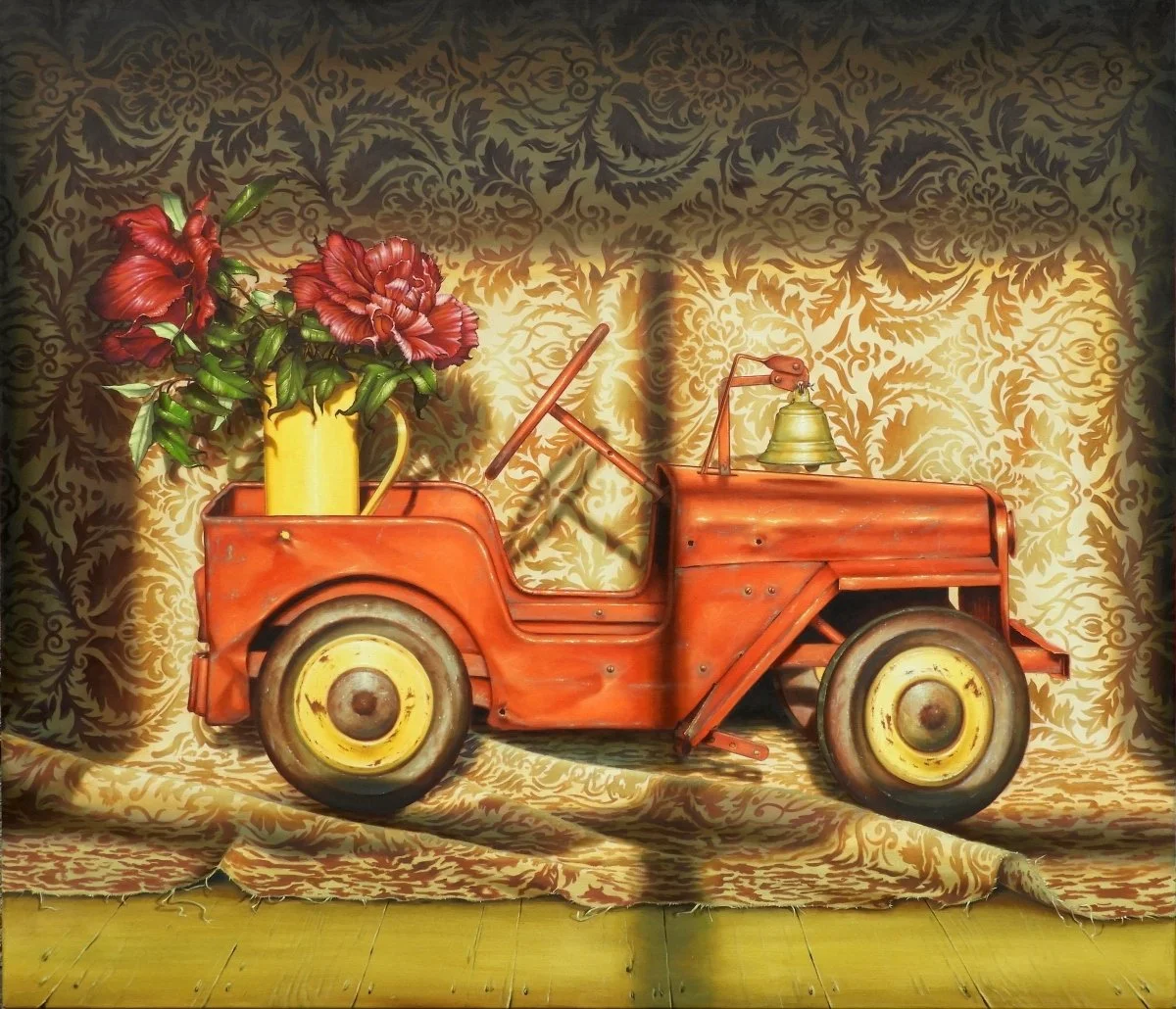
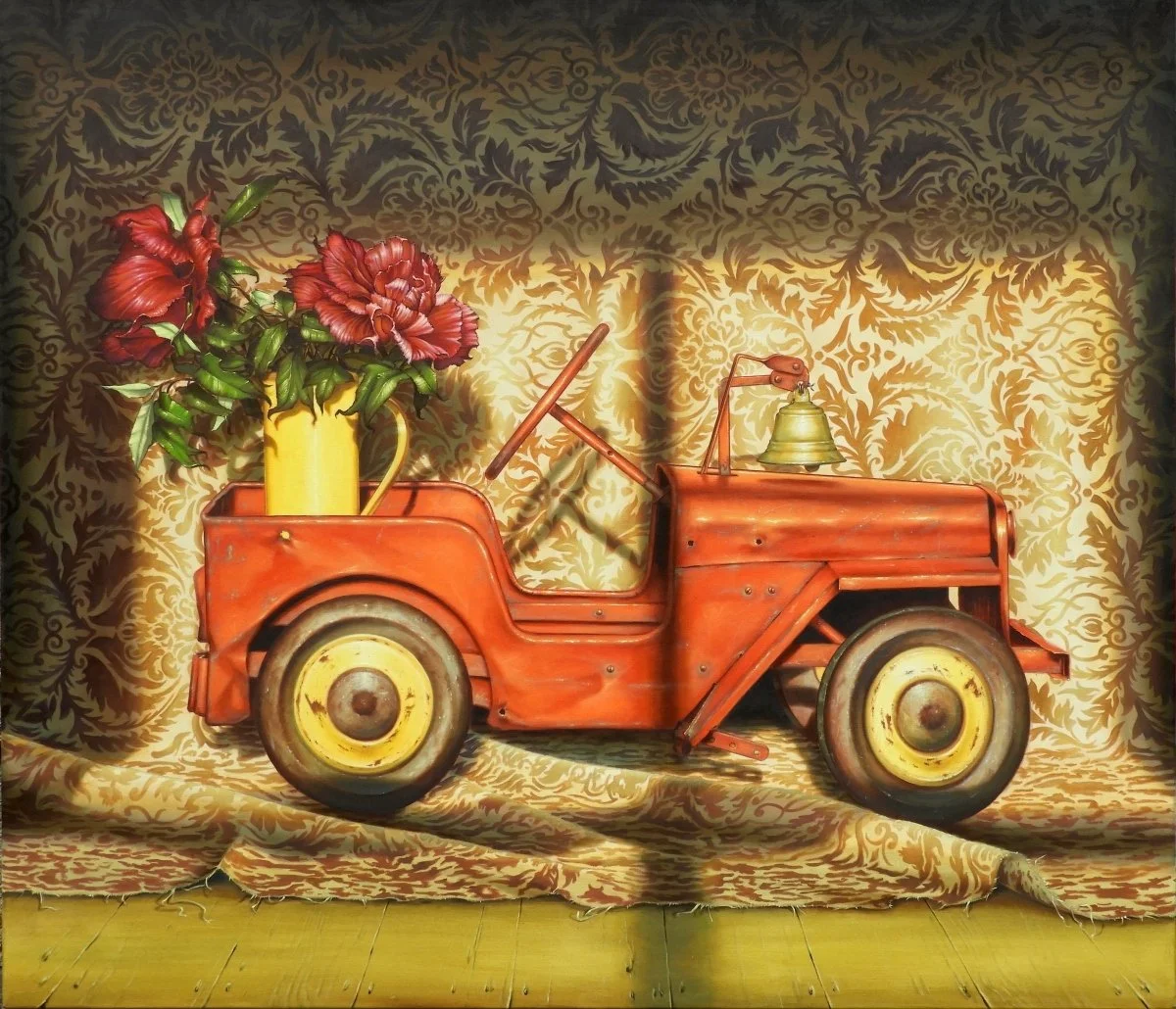
An old red car has a frequent presence in your artwork. What is the story behind this?
This toy red car was found in an auction house 30 years ago, It was brought home with the idea that I would refurbish it and keep it as piece of interest, but it got lost, under rolls of insulation and old bags of cement, buried in the back of the old shed. But when covid arrived, we were all in isolation and lockdown and I had a dream. My mom was not doing so well, as a widow and cut off from everyone, I lived 100 miles away. I dreamt I was in the child's red car, peddling fiercely up the motorway to visit my mom, a vase of freshly cut flowers in the back, when - there was a roadblock, and a police woman stopped me and wanted to know where the hell I thought I was going, in that thing, in the middle of a pandemic. I told her my mom wasn’t doing too good and I wanted to see her and bring her some flowers, a few beats passed and she leaned down to me and sternly said, ‘you go to your mom but don’t you dilly dally and you come straight back home’. I then woke and went searching for the red car, cleaned it off and I have been painting it since.
Out of all your work, which has been your favourite to work on, and why?
Who is your favourite child, its the age old question, do we have favourites, privately, I believe we do, but some for different reasons. But here are my favourites
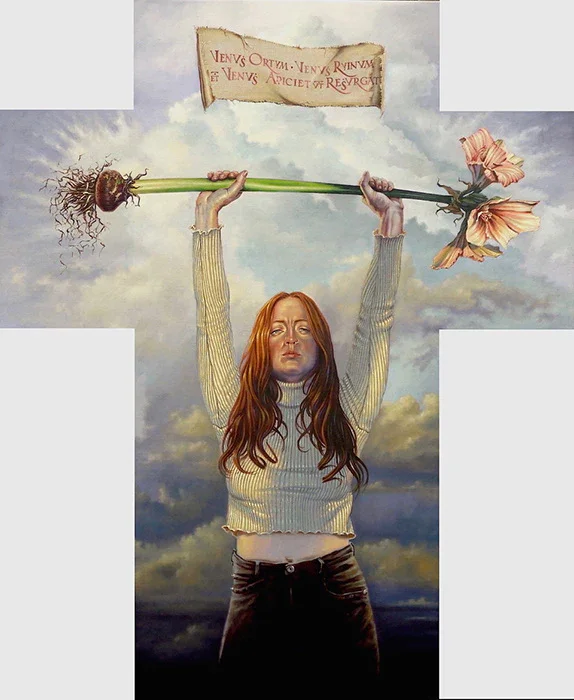
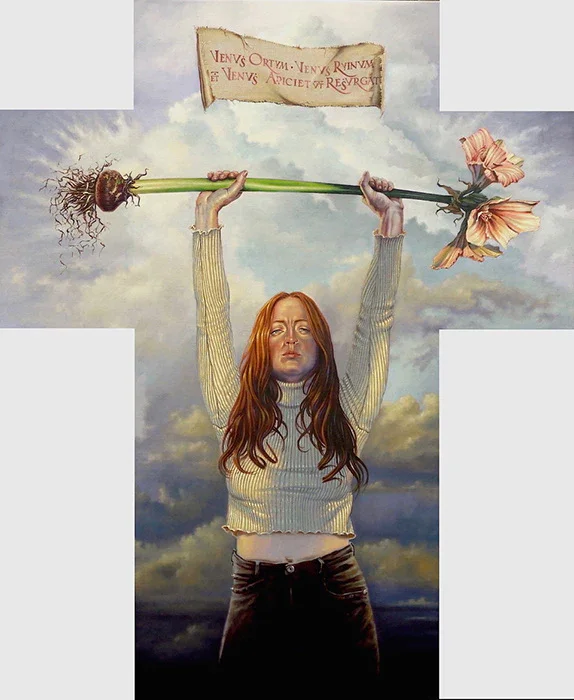
‘Venus rising’
Its message is strong, its shape is obvious, it is unflinching in its defiance and believe.
‘Bringing flowers to my mom’
This piece has an very emotional attachment for me, but the light and pattern and execution, I still enjoy
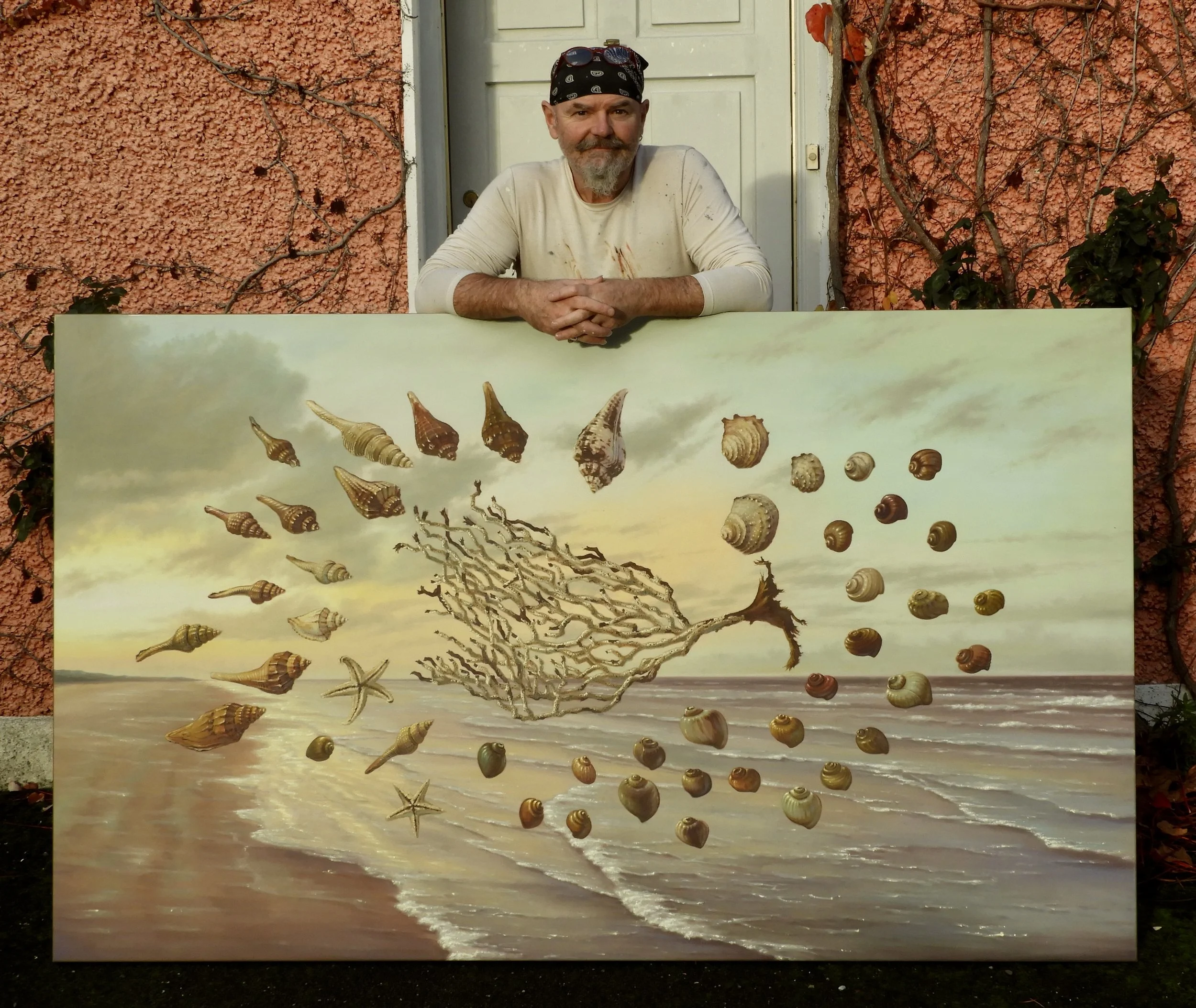
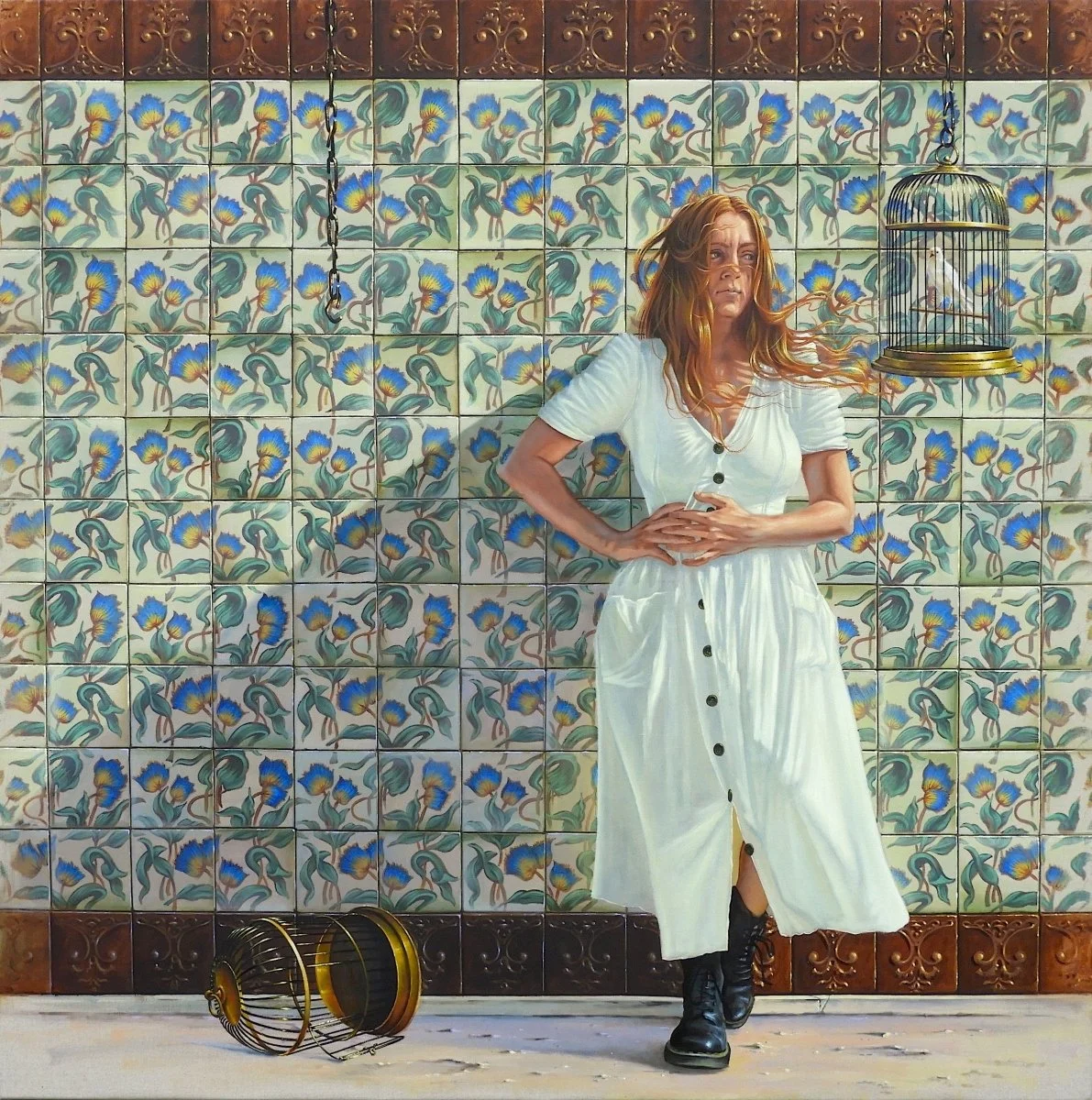
‘Cages’
There is something wonderful about knowing you have achieved what you wanted. Depicting light, the way you saw it
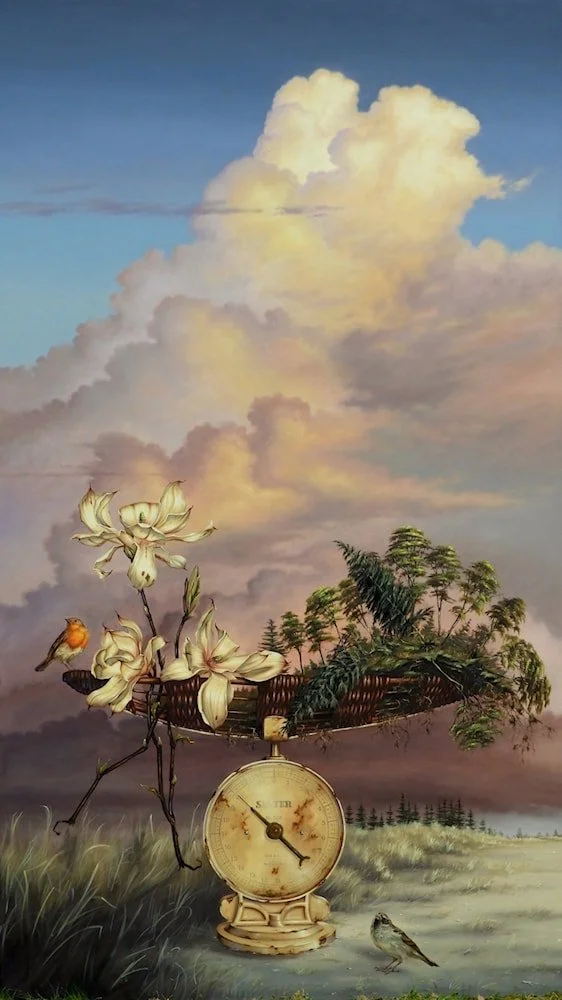
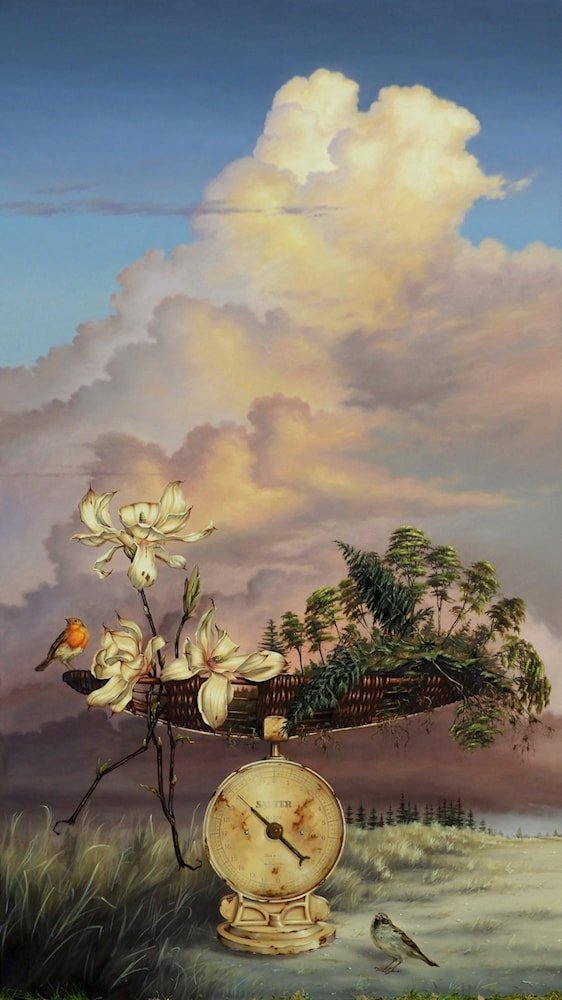
‘Profit and loss’
I still feel sadness when I look at this, I paint nature and its troubles constantly, but this one still moves me.
If you could spend a day with an artist; dead or alive, who would it be, and why?
Salvador Dali, he was a true inspiration to me as a child, I would get books from the library and pour over them, I could not imagine how he achieved what he did.
I marvelled at his concepts and fell in love with his light, he is my inspiration. Barking mad as he was, that would be a day very well spent.

The Yellow Scarf - Acrylic on linen 80cm x 90cm
This piece came about from one Winter, when we were in Glasgow, visiting my brother, we were out shopping and wandering about the streets of downtown, Glasgow - Argyle Street and Sauchie Hall Street. It has a lovely, lively city centre, with all kinds of street performers, out doing their thing, plying their trades, mimes, puppeteers, bible thumpers, panhandlers, charity collectors and some fine musicians.
Onwards we went, stopping into the odd bar, for a little encouragement, while watching the people come and go, young lads out on the piss, bar flies that were dribbling there all day, an old woman walked in, laden down with bags of shopping, ordered a whisky, necked it and walked out, it was starting to get a bit rowdy by then, so out we went ourselves, and onwards up the streets.
Jade had ducked into one of the High Street shops, said she would follow me on, and I ambled on up the way. I found a mural painter doing some great work just off Argyle Street and was absorbed in watching him bring it to life, it was very cool and I told him so and then left him to it, then onwards I went.
Jade caught up with me and had her latest purchase, this great, big fluffy, yellow scarf, intense and loud and just what you’d need of a winters day in Glasgow. I saw a green tiled wall and married the two together with a bright Winters sky for a lovely end to a very colourful day.
What has been your greatest achievement so far as an artist? What are your future aspirations?
My biggest success has been to exhibit with artists I really admire, artists whose work intimidates me. Over the recent years I have found my work accepted into more international shows, prestigious shows, and although I sometimes feel imposter syndrome, I always try and quell that with the fact that I have worked very hard to get here, and to get here took persistence and determination, which are both - omnipotent.
I am working hard to achieve more, I have been part of the Lunar Codex that is establishing a library of the arts and humanities on the moon, Royal Academy Shows, Biennale shows, international shows, but it's always about the same desire. To have your work seen, understood, acknowledged.
Why do you think art is important in society?
I think it may be a truth, that society wants to know, it is definitely a mirror, for I am only painting what I am experiencing, worts and all. There is an absolute, when a viewer, listener or buyer is stopped, affected and moved by a piece of art, music or literature. There is a soul swirling about and within the arts - and I would not like to experience a society without a soul.